

Enough With Strategic Planning. Your Real Job is Strategy.
Why teams confuse the two – and how real strategy actually forms

Strategic Planning – The Annual Trap
Every year, as Q4 winds down, executive teams settle into the familiar ritual: the annual planning gauntlet. Boards expect confidence heading into the next fiscal year. Finance asks for clarity so they can lock next year’s budgets. Business units prepare Q1 kickoff decks. Chiefs of staff circulate templates.
As Roger Martin notes in “The Big Lie of Strategic Planning,” annual planning often creates an illusion of certainty rather than true strategic choice.
And here’s the problem: Most companies believe they are doing strategy work at this time of year. They’re not. They’re doing planning. And they are mistaking the planning cycle for the strategy conversation they never actually had.
This confusion is understandable – it happens in nearly every organization I work with – but it’s also quietly corrosive. Planning without strategy produces the illusion of alignment: detailed initiatives, KPIs, scorecards, progress trackers, and polished decks. Meanwhile the company remains strategically unmoored, busy but directionless. Teams sprint hard in parallel but not in concert. Choices get made based on personality or proximity rather than a shared view of what will win.
The cost of this confusion is immense, especially in dynamic industries. But the remedy is simple, though not easy: protecting real strategy work from being swallowed whole by the planning machinery.
What follows is a clearer distinction, an overview of why teams confuse the two, and a practical way to reclaim strategy as the leadership team’s core job.
Most companies believe they are doing strategy work. They’re not.
What Strategy Actually Is (and Isn’t)
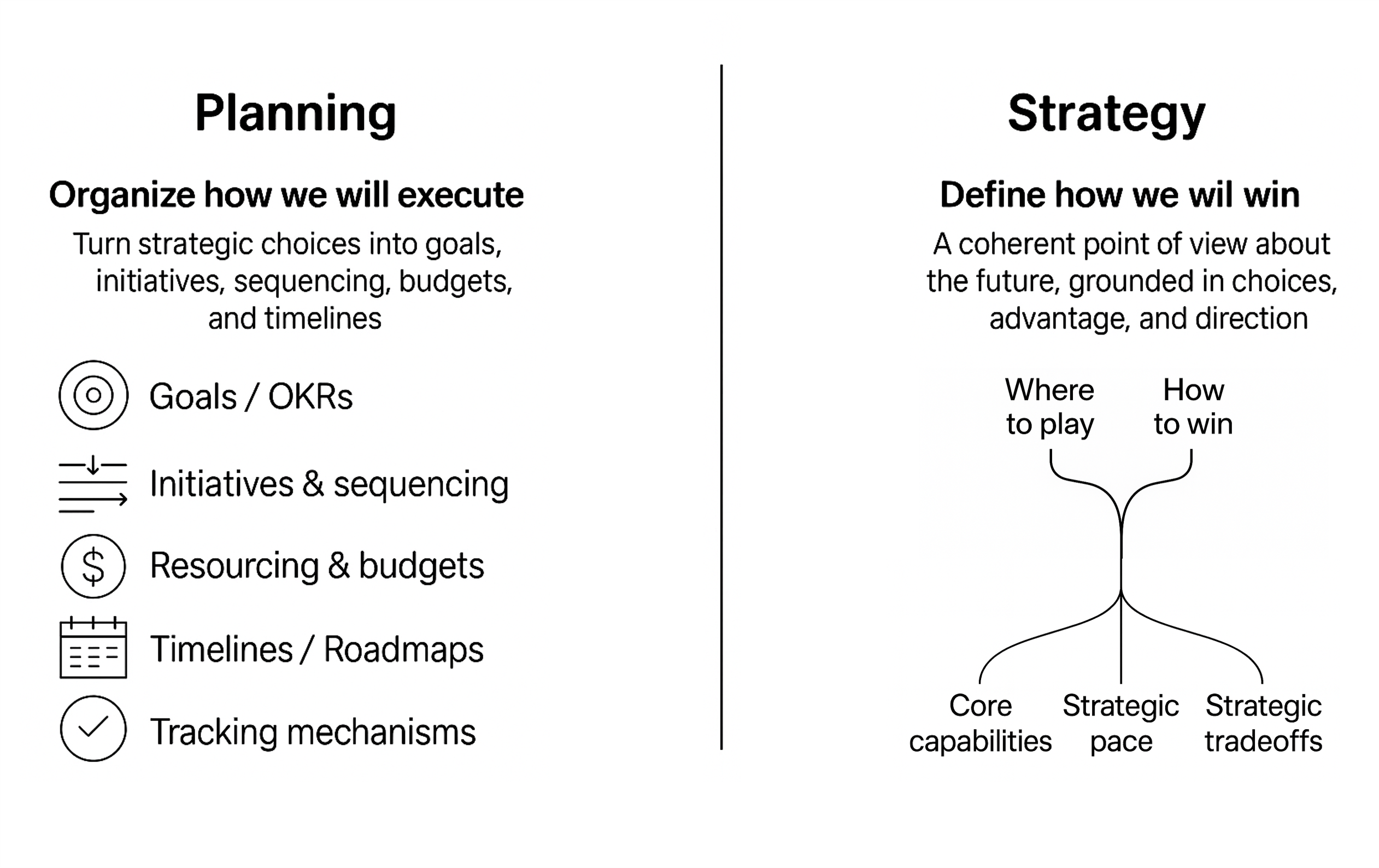
Strategy is the coherent answer to the question “How are we going to win?”
It is not a mission statement, an objectives list, an initiative prioritization, a roadmap, a spreadsheet, or a wishful north star proclamation.
Strategy is a point of view about the future. A real one. It defines:
A destination: the world you intend to create and the position you want to hold within it.
A chosen game: which customers, problems, markets, and battles matter most.
A way to win: the specific capabilities, advantages, and tradeoffs that make your chosen path winnable.
Put differently: a strategy is a set of choices and a logic for why those choices create advantage.
Lafley and Martin’s book, “Playing to Win,” frames these choices as where to play, how to win, and the capabilities and systems required to support those choices. Whether you use that foundational methodology or a narrower built-for-purpose framework, the message is simple.
A good strategy doesn’t require 60 pages, though it must be:
Clear and compelling enough to remember
Specific enough to matter
Coherent enough to guide real decisions
The real test is simple: If I confiscated your deck, would the team still be able to articulate the strategy? And would the next level be able to use it to make decisions without you?
If the answer is no, you don’t have a strategy. You have a plan-shaped object.
Why Companies Mistake Planning for Strategy
Strategic planning is the process of operationalizing strategy:
Setting goals and OKRs
Defining initiatives, sequencing work and assigning work
Allocating budget and setting timelines
Planning turns a strategic point of view into an executable system. Done well, it is invaluable.
But here’s the trap: While planning organizes effort, only strategy ensures the effort is pointed somewhere worth going. And it is the job that only the executive leadership can do on behalf of the company. As a team.
1. Planning is familiar; strategy is uncomfortable. Planning comes with templates, inputs, outputs, and timelines. Strategy comes with ambiguity. It forces executives to reveal their assumptions, uncertainties, and logic … then contend with misunderstanding and misalignment on the team. Planning feels like progress while strategy feels like exposure.
2. Planning avoids conflict; strategy requires it. Planning allows functional leaders to prioritize within their silos and stay in safe territory. Strategy demands tradeoffs among leaders. It demands saying no to good ideas. It demands debating what really matters. Most leadership teams unconsciously avoid that.
3. The annual cycle pushes planning to the front. Boards expect a “deliverable,” be it an AOP, an LRP, a Strategic Intent – with a budget, prioritized initiatives and clarity on next year’s KPIs. So, teams announce they’re “doing strategy” when they’re really doing the mandatory annual planning cycle. The gravitational pull of the cycle overwhelms everything else.
4. Busy executives sacrifice thinking in order to survive. Leadership teams are time-starved and overloaded. When calendars get crushed, the first casualties are deep thinking, cross-functional alignment, strategic clarity, and real debate effort that gets you there. And because talented execs can still produce plans without strategy, the company convinces itself everything is fine.
5. Talented analysts (and now AI) make planning look deceptively strategic. Slide after slide of analysis, initiative lists, competitive snapshots, and TAM expansions. None of it answers the question “How will we win?” But it looks strategic enough to pass for the real thing.
As HBR’s “A Plan Is Not a Strategy” argues, plans describe activities under control, while strategy specifies how a team intends to win under uncertainty. You need both. The problem is not planning itself, it’s when planning is asked to substitute for strategy.
The Cost of Substituting Planning for Real Strategy
The consequences of confusing planning with strategy aren’t abstract – they show up everywhere. You see them downstream in execution: next-level leaders struggling to align their actions to company goals, constant escalations, surprise issues that should never be surprises, and frenetic activity with little meaningful progress.
But these aren’t execution problems. The real cause is upstream, in the quality of strategic dialogue. You can be an outstanding planner and still be strategically adrift.
And when strategy is reduced to planning, the pattern of symptoms shows up again and again:
1. Executing brilliantly toward the wrong thing. This is the Titanic problem: You can optimize the engine room beautifully while heading straight toward the iceberg.
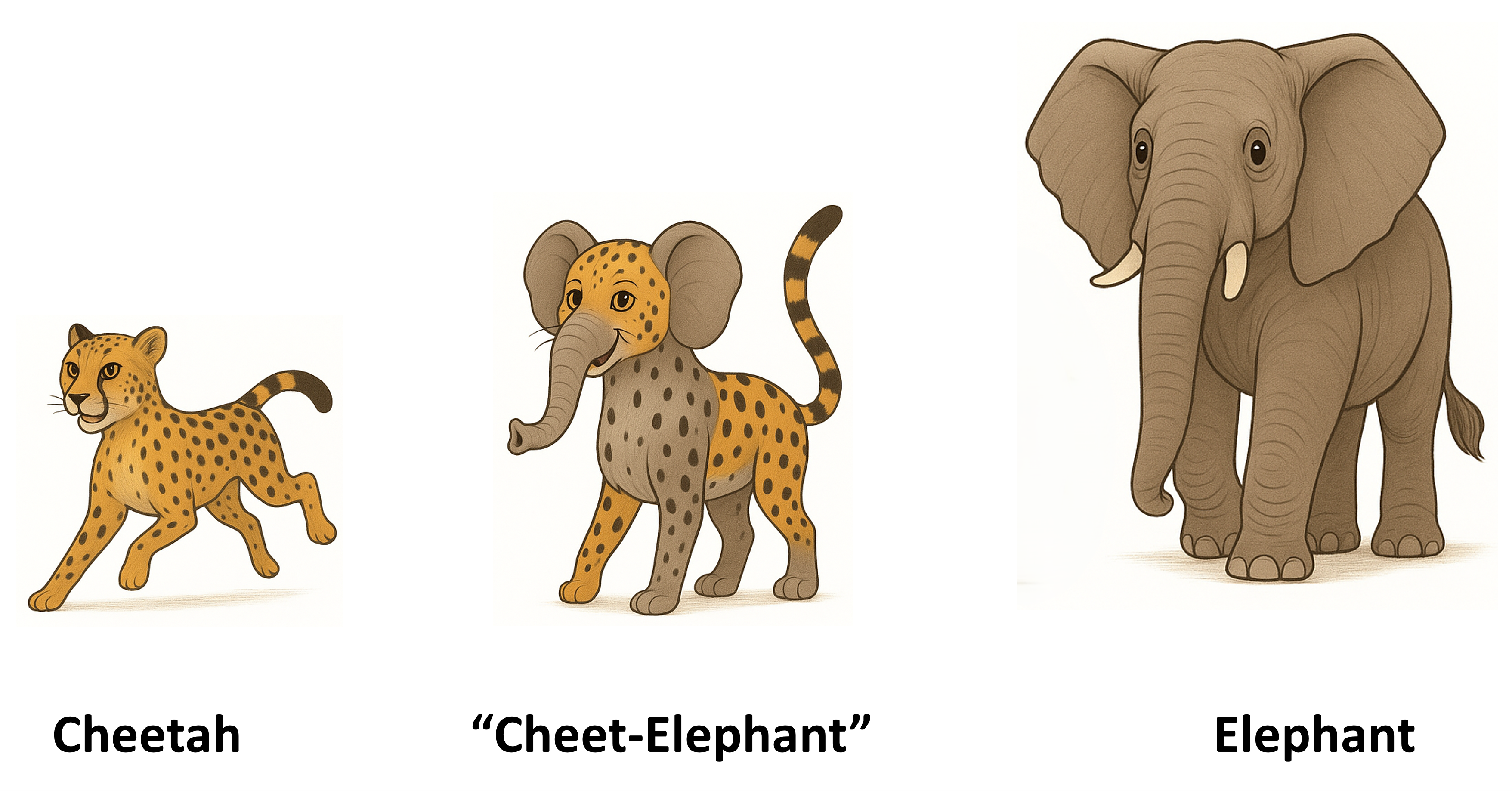
2. Priorities fragment into a “Cheet-elephant.” One-off prioritization feels strategic, evaluating impact-vs.-investment, but it produces incoherence. You can be a cheetah (agile, fast) or an elephant (heavy, powerful), but not both. Trying to be both – by prioritizing without a sense of a unique gameplan for winning – produces a Cheet-elephant, a creature that cannot compete.
3. Leaders tell different stories. At All Hands, a VP says one thing. In staff meetings, directors say another. With engineers, something else. With customers, yet another. This is how companies unintentionally create internal dissonance and market confusion.
4. Next-level execution breaks down. I have heard top execs complain that “next level leadership is where strategy goes to die.” Usually, the issue starts upstream. Next-level leaders aren’t task-runners; they make dozens of judgment calls per week. Without a shared strategic logic, they make inconsistent calls, escalate everything, resolve conflicts politically or expediently, and drift toward short-term optimization.
It happens more often than leaders admit. But what they DO notice is that noise multiplies, energy dissipates and momentum dies.
What To Do Instead
Roger Martin’s “Strategy vs. Planning: Complements not Substitutes” reinforces the need to separate strategy formation from planning mechanics. The remedy isn’t complicated, but it is uncomfortable: Put strategy first.
There are two workable models I have seen across high-performing leadership teams:
Model 1: Put strategic assessment before planning.
In the early fall (or late Q3/early Q4, whenever your cycle is), conduct a real strategy conversation. Make sure to ask pivotal questions:
What’s changing in our market?
What future are we choosing?
What tradeoffs are we making?
What logic will give us advantage?
Then, and only then, begin planning.
Model 2: Adopt a continuous strategy cadence.
For dynamic industries or companies under 3,000 people, annual strategy is too slow. Instead, treat strategy as a quarterly capability:
Identify one or two strategic questions
Prepare individually
Debate together
Clarify implications
Integrate insights into operating and organizational decisions
This breaks strategy into manageable, high-quality conversations that don’t get swallowed by planning. Either way, the rule is the same: Strategy decides; planning organizes.
How Leadership Teams Actually Do Strategy Work
Once you acknowledge that strategy is the leadership team’s core job – not a deliverable to be outsourced – the question becomes: Okay, so how do we do this well?
Here’s a sequenced approach I use with executive teams:

1. Identify the real conversations you need to have. Most teams know where misalignment lives – they just haven’t named it. Surface the unsettled questions that create friction. For example:
Which customers matter most?
What are we actually differentiating on, and can we win with that?
What capabilities must we build to deliver that differentiation?
How fast do we want to grow, and at what cost?
What tradeoffs are we willing to make, and what will we explicitly stop doing?
If the list feels comfortable, it’s incomplete. Not kidding, ask your insightful next level leaders. They will gladly tell you where you are being unclear.
2. Prepare individually before the group meets. Ask each leader to write their point of view, their assumptions, and the logic behind their recommended choices. The goal isn’t precision; it’s clarity about where people stand and why they think what they think. This prep is what makes the later debate productive rather than meandering.
3. Come together in person. Virtual meetings handle updates (and most strategic planning!) beautifully enough. They do not handle strategy. Tradeoffs, divergent views, emotional nuance, and hard intellectual conflict require co-presence. In-person time is the accelerator.
4. Embrace productive conflict. If everyone agrees quickly, someone is hiding their real view. Or worse, everyone is thinking too small and superficial. Strategy requires disagreement. You want heat – the right kind of heat: Focused, grounded in logic, not personal, and held in a safe container. A good facilitator helps, but the executives must want the conflict.
5. Drive to alignment and clarity. Debate is not the destination. Clarity is. Name the choices. State the logic. Make implications explicit. And then adopt both sides of the discipline of “disagree and commit.” This means that every member of the team – now that the debate has been held in its fullness – will support any decision (in action, words and spirit) as if it is their preferred outcome, even when it still is not.
6. Engage to internalize guidance. A strategy that stays in the room is not a strategy. The team must be able to articulate the narrative, the logic and the implications in a few crisp sentences that can be cascaded. This communication is not just a deck; it requires real conversation. Rather than just passing the baton with a baked preso, invest in bringing together next level leaders to internalize, ask questions, identify implications, and think ahead towards collaborative implementation with peers.
This is what transforms strategy from an intellectual activity into organizational momentum.
Strategy is a team contact sport — you can’t do it alone and you can’t do it in your head.
Closing Thought
When leadership teams protect time for real strategic dialogue – structured thinking, genuine debate, clarity of choice, a compelling narrative – they stop confusing motion with momentum. Planning becomes sharper, cleaner, and faster because it is grounded in something that actually matters.
Strategy is not a deck. Strategy is not a ritual. Strategy is the leadership team doing the one job only they can do: choosing how the company will win.
Great article, Daniel. Literally had this conversation today with an exec who is doing planning vs asking the tough strategic questions. It's a tough knot for leadership teams who don't have useful skillsets to navigate the most challenging conversations.
Love the analysis and clarification. Recommendations are concrete and practical. Maybe too late for this Q4 2025 but I will keep it my mind for 2026. Thanks