

Doing Strategy with Noses Pressed Against the Singularity
Coherence, Conviction, and Finding a Way Forward in a World That Won't Stand Still

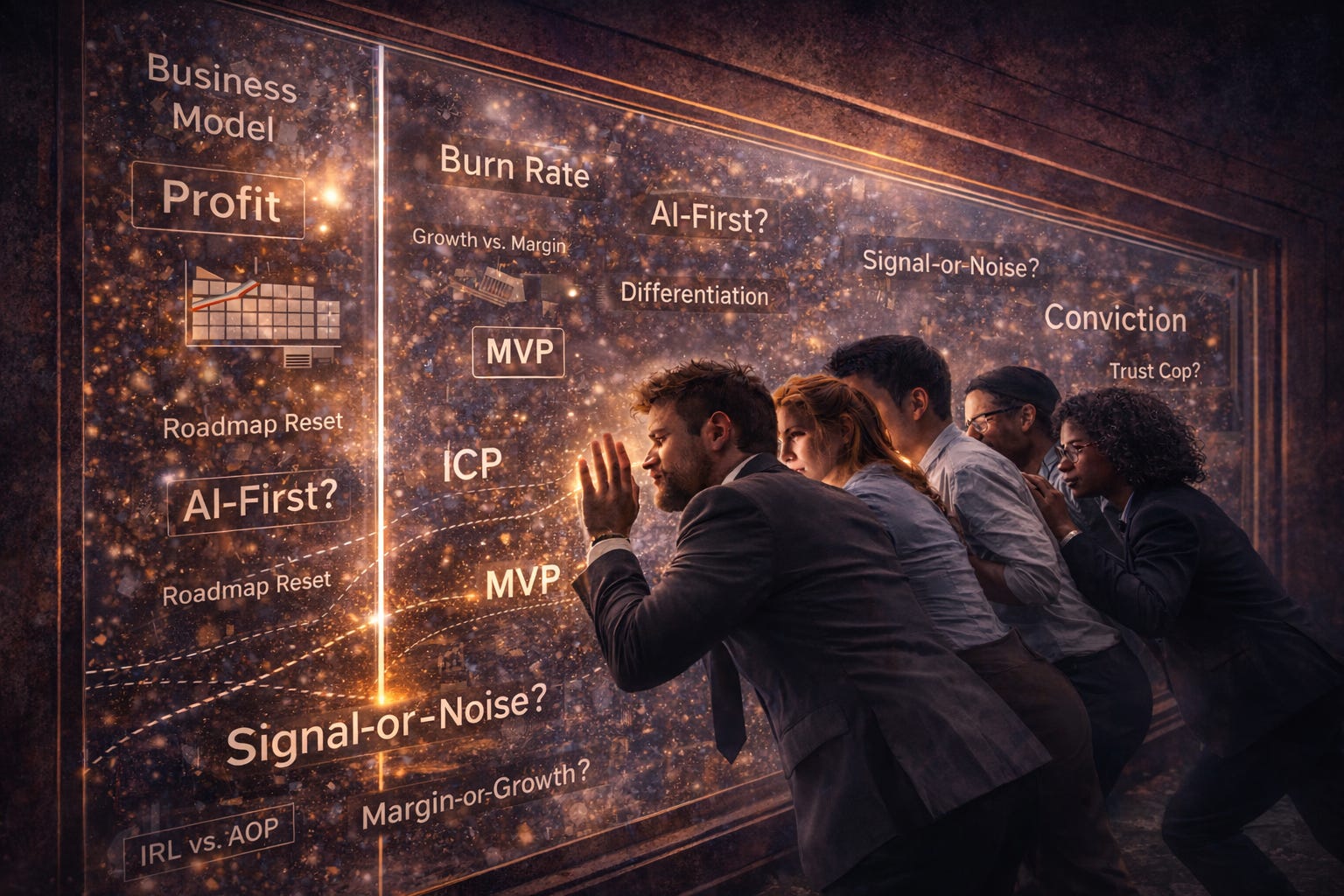
There is a particular feeling that accompanies doing strategy right now. It is not merely urgency, and it is not simply complexity. It is the sensation of having your nose pressed up against the singularity — so close to rapid technological inflection and competitive acceleration that the horizon itself becomes difficult to see clearly.
Most leaders in this environment know the feeling intimately, even if they rarely name it. It is the experience of walking into a room to make a high-stakes decision while holding five contradictory signals from five different directions. It is the quiet cognitive weight of never quite having enough clarity, and yet being expected — by your board, your team, your investors, your customers — to project conviction. It is the fatigue of a world that generates more input than any leadership team can coherently metabolize, and the subtle anxiety of wondering whether the decisions you are making today are landing on ground that will still be there tomorrow.
It is also, often, a lonelier experience than it looks from the outside.
Leaders across industries are experiencing a version of this. The environment does not pause long enough for comfortable reflection. Markets shift in months rather than cycles. Customer demands evolve before solutions are fully deployed. Competitive signals arrive faster than they can be integrated. And yet the work of leading an organization — of setting direction, aligning people, making tradeoffs, and executing — goes on. The stakes do not decrease because the environment is difficult. If anything, they feel higher.
This piece is not about pretending that difficulty away. It is about finding a way to navigate it with more coherence, more honesty, and more shared conviction than the environment naturally allows.
The Problem Isn't Speed. It's Distributed Perception Under Speed.
When people describe the difficulty of strategy in this environment, they often point to velocity. Things are moving faster. Decisions have shorter half-lives. Plans go stale. All of that is true. But velocity alone is not the deepest challenge.
The deeper issue is that speed interacts with something structural inside every leadership team: each leader is closer to different signals than their colleagues. The CEO is absorbing board expectations and investor narratives. The head of sales hears directly from customers about what is landing and what is not. The product leader tracks competitor moves and technological shifts. The CFO feels the pull of capital efficiency and margin discipline. The COO sees the operational strain of teams absorbing constant change.
Each vantage point is legitimate. Each is grounded in real data and real experience. Each gives rise to a rational interpretation of what the organization should do next.
Under calmer conditions, those interpretations can be integrated over time. Under the current conditions — when the environment shifts faster than the integration cycle — they evolve in parallel, quietly, without anyone noticing. Leadership teams can find themselves operating from different mental models of their own situation without ever having a conversation that makes that divergence visible.
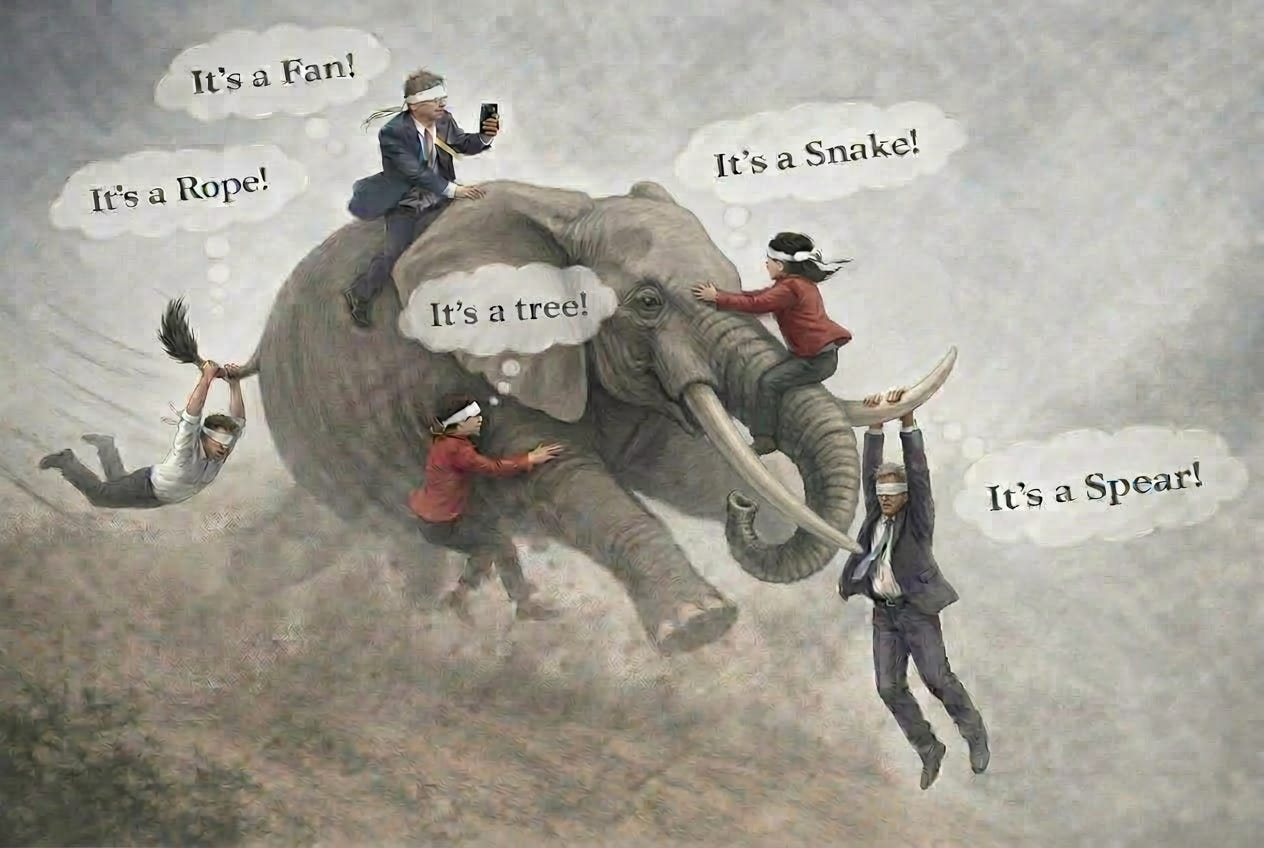
This is the old parable of the blind men and the elephant. But the elephant is moving erratically.
The result is not confusion. It is something more subtle and more costly: intelligent fragmentation. Each part of the organization pursues a direction that makes sense from its vantage point. Collectively, those directions don't fully cohere.
It shows up as messaging that drifts by audience. Product sequencing that reflects different unstated priorities. Pricing logic that varies by deal. Cross-functional friction that is hard to trace to a source. Externally, the organization may still look decisive. Internally, it is working harder than it should to compensate for divergence that was never surfaced.
And the human cost is real too. Leaders in these conditions often describe a low-grade exhaustion that isn't simply about workload — it's about the energy consumed navigating ambiguity that should have been resolved, relitigating decisions that should have stayed anchored, and managing tensions that could have been named openly. Teams feel it as well. When the organizing logic isn't clear, smart, committed people fill the vacuum with effort. They work harder to compensate for what alignment would have provided freely. That is a tax on performance and on people.
In markets where timing, coherence, and disciplined execution determine outcomes, that fragmentation carries real cost. Execution slows not because people are incompetent, but because they are navigating from different maps.
This is why strategy, in AI-speed environments, must evolve beyond selecting a direction. It becomes the deliberate alignment of interpretation before the alignment of action.
Why the Old Playbook Isn't Enough
Most of us who work in strategy were trained on frameworks built for a different tempo. Industry analysis. Competitive positioning. Multi-year roadmaps. These tools carry real wisdom. The underlying questions they ask — about competitive dynamics, economic tradeoffs, customer evolution, and capability gaps — remain genuinely important.
But those tools were designed for environments where you could step back, analyze deliberately, and act with reasonable confidence that the variables would stay relatively stable during the exercise. In many industries today, that assumption is under strain.
By the time a comprehensive strategic analysis is complete, some of the answers are already provisional. The environment kept moving. This isn't a failure of rigor — it is a mismatch of tempo.
The issue is not that classical strategy is wrong. It is that it must be compressed and embedded rather than executed as a full standalone process. It must employ collective intuition with imperfect information. Its insights must serve a more immediate question: given everything we understand about our competitive position, our customers, and our capabilities right now, what is our best game plan for the next 3-6 months?
That shift — from comprehensive analysis toward time-bound, embedded judgment — is one of the genuine adaptations that leading in this environment requires.
What Strategy Needs to Become
When the environment is this fluid, strategy needs to do something that long-range planning was never quite designed for: it needs to create shared interpretation among people who are each seeing different parts of the picture.
This is more than alignment on goals. It is alignment on the underlying frame — on what is being optimized and why, on what is primary and what is secondary in this moment, on what risks are being consciously accepted and what tradeoffs are inherent in the chosen direction.
Without that shared frame, organizations accumulate drift. Not because people are wrong, but because they are reasoning from different organizing logics. One function leans toward enterprise credibility. Another pushes for speed and expansion. A third focuses on operational stability. Each move is defensible. But together, they fragment.
With a shared frame, something different becomes possible. Next-level leaders make decisions more consistently without needing constant escalation. Cross-functional conversations become less about relitigating premises and more about solving problems. The organization's operating tempo can increase without amplifying internal noise.
Alignment, in this sense, is not about harmony for its own sake. It is an execution-at-speed lever. In environments where fast, coherent execution is a source of advantage, the ability to move as an integrated organization — rather than as a collection of rational but divergent parts — is genuinely consequential.
The "AND" Problem
One pattern that surfaces consistently in leadership teams navigating this environment is what might be called the "AND" problem.
The language of ambitious organizations tends to hold multiple directions simultaneously. We are pursuing growth and efficiency. We are serving mid-market and enterprise. We are building for now and positioning for the future. Most often, some version of "both" is indeed the right answer. Complex environments rarely reward false simplicity.
The difficulty arises when "AND" is left structurally undefined.
Does it mean parallel workstreams with dedicated resources? Different timelines for different priorities? Differentiated messaging for different audiences? One emphasis now, another later? Without that specificity, each function fills in its own interpretation. The "AND" that felt like a shared answer at the leadership level becomes a source of divergence one level down.
It is worth being clear about what is at stake here. Resolving the "AND" is not primarily a communications exercise — it is not about tweaking external narrative or refining messaging. It is fundamental to questions of execution: which bets get resourced, which markets get prioritized, how deals get priced, what M&A makes sense, and where the organization concentrates its energy. Ambiguity at this level doesn't stay at the top — it cascades.
The work of strategy in these environments therefore involves not just identifying the right direction, but specifying the structure beneath it — what is primary now, what is intentionally secondary, what would cause the emphasis to shift, and what does this mean concretely for how different parts of the organization should operate.
Stability and Agility at the Same Time: The Bi-Focal Discipline
One of the most useful reframes for doing strategy in extreme uncertainty is what I think of as a bi-focal discipline — the practice of holding two different time horizons with different levels of clarity, simultaneously.
The longer horizon — a genuine picture of the kind of organization you are trying to become over the next three years or so — remains essential. Not as a rigid plan, but as an anchor for identity. It stabilizes talent. It guides capital allocation. It provides a coherent narrative when the external environment is generating noise. This is the 20/80 view: directionally clear, open to revision in the details.
The shorter horizon is where the real strategic work happens in this environment. Given everything we know and everything we are uncertain about right now, what is our game plan for the next three to six months? What are we optimizing? What are we explicitly not optimizing? What tensions are we prepared to absorb? What would cause us to revisit this emphasis? This is the 20/20 view: sharp, time-bound, operationally translatable.

This near-term clarity is not a retreat from ambition. It is what allows ambition to be pursued coherently under volatility.
The bi-focal discipline creates something that might otherwise seem impossible in a VUCA environment: stability and agility at the same time. The longer horizon provides the north star. The near-term game plan provides maneuverability. Together, they allow organizations to move quickly without reopening foundational identity questions at every turn, and to adapt intelligently without drifting.
The Real Work: Surfacing What Hasn't Been Said
Perhaps the most underappreciated part of doing strategy right now is making implicit assumptions explicit.
Leadership teams are often more fragmented than they appear — not because they lack intelligence or good faith, but because important interpretive differences have never been surfaced. One leader may believe that enterprise expansion is fundamentally about investor signaling. Another may see it as a margin play. A third may worry quietly that it is an operational distraction. Each view is grounded in real experience. If unexamined, those differences don't disappear — they migrate into execution, where they manifest as friction and inconsistency.
Similarly, concerns about sequencing, risk tolerance, or the viability of a chosen direction may go unspoken in cultures that reward decisiveness. Silence becomes mistaken for clear understanding and actionable agreement.
The real work of reaching alignment therefore involves more than converging on a direction. It involves creating the conditions for honest exploration — space where leaders can name what they believe must be true for a chosen path to succeed, articulate what genuinely worries them, and hear the logic behind perspectives that differ from their own.
This is harder than it sounds. It requires a kind of psychological safety that is not always present in high-performing teams, where admitting doubt can feel like a liability. It also requires intellectual rigor — the difference between real exploration and the performance of exploration is meaningful.
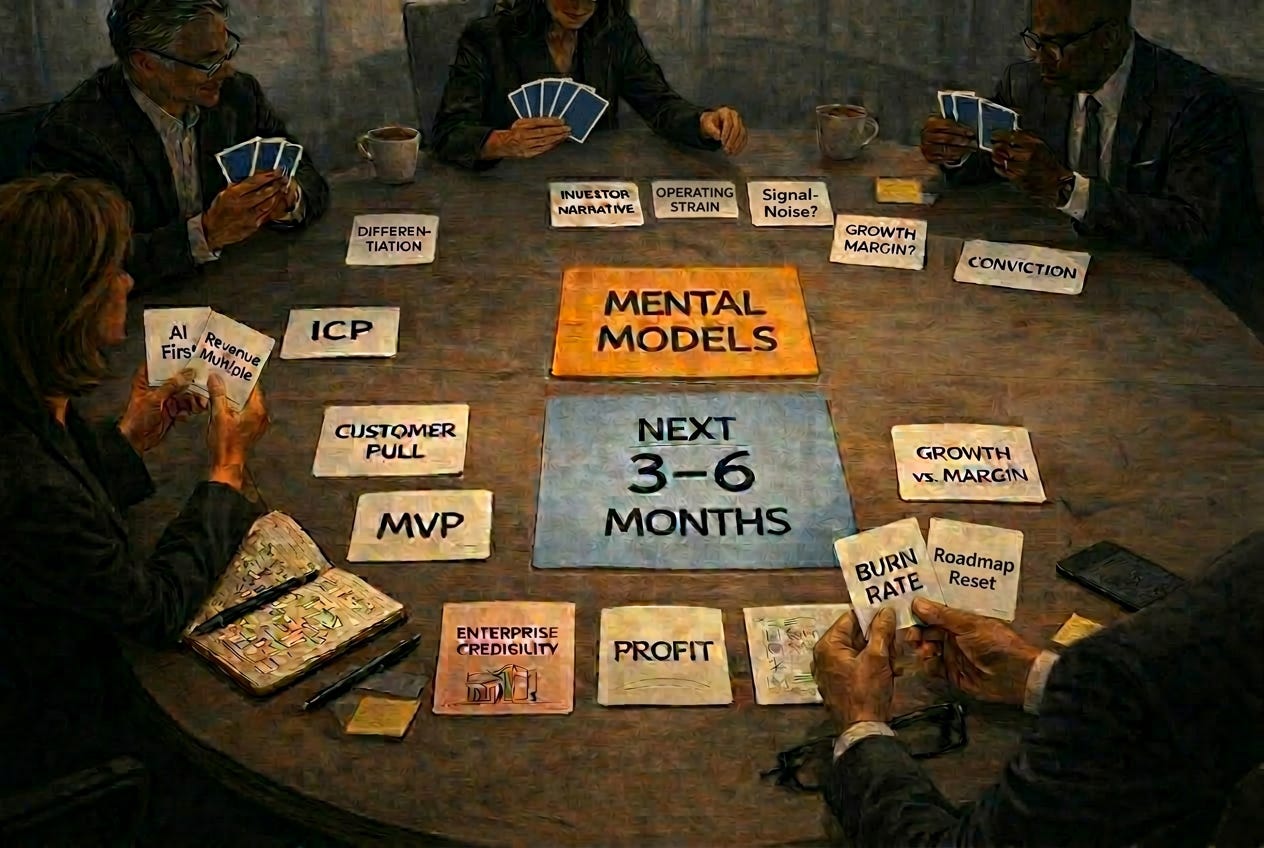
There is also something quietly relieving about this work when it goes well. Leaders who have been carrying private concerns — about sequencing, about risk, about whether the organization is really ready for what it is committing to — often find that naming those concerns out loud is itself a form of relief. Not because the concerns disappear, but because they are no longer being managed alone. The team can carry them together.
When teams do this work well, something shifts that goes beyond strategic clarity. The room feels different. People are less guarded. Debates become more honest and, paradoxically, more productive. There is less energy going into positioning and more going into actual thinking. That shift in the quality of conversation is not incidental — it is part of what makes the resulting alignment durable.
A Way Forward
What I have described here is not a new strategy framework. It is a different orientation to the work — one that starts from empathy for what leaders are actually experiencing, rather than from a template to be filled in. The approach I use with leadership teams reflects this orientation.
It begins with listening — through individual conversations that allow leaders to be candid in ways that group settings sometimes don't permit. Patterns of divergence, unspoken assumptions, and differences in mental models tend to surface more clearly when people are not managing their positioning in front of their peers.
Facilitation then creates a structured container for bringing those differences into the open. The goal is not to force consensus prematurely, but to help teams inhabit alternative directions long enough to understand the real tradeoffs — not just the surface logic, but the risks, the dependencies, and the implications for how different parts of the organization would need to operate.
From there, the work moves toward explicit, time-bound emphasis — and then into translation. What does our chosen direction mean for how we go to market, how we price, how we hire, how we sequence product development? Alignment that lives only at the level of strategic statements tends to dissolve under the pressure of day-to-day decisions. Alignment that has been translated into operating doctrine endures.
Throughout, the orientation is calm rather than urgent. The environment generates enough urgency on its own. What leaders often need most is not more pressure to decide, but a space to think clearly, surface what has been implicit, and find genuine conviction about a direction they can commit to together.
The aim is something more achievable and, in its own way, more valuable: a leadership team that thinks well together, that can hold disagreement without fracturing, that moves with shared conviction rather than managed consensus. People who feel less alone in the complexity, and more capable of navigating it side by side.
In a world where noses are pressed against the singularity, that capacity is not just useful. It is the work.
Daniel Levitt is the founder of Exember Inc. He works with senior leadership teams to build strategic alignment, navigating the intersection of organizational clarity and high-velocity markets.